DOM Tenerife · Insight
Costa Adeje attracts international capital seeking income-generating real estate in Europe’s subtropical south. Understanding permitting, taxation, and realistic yields separates sound investment from costly error.
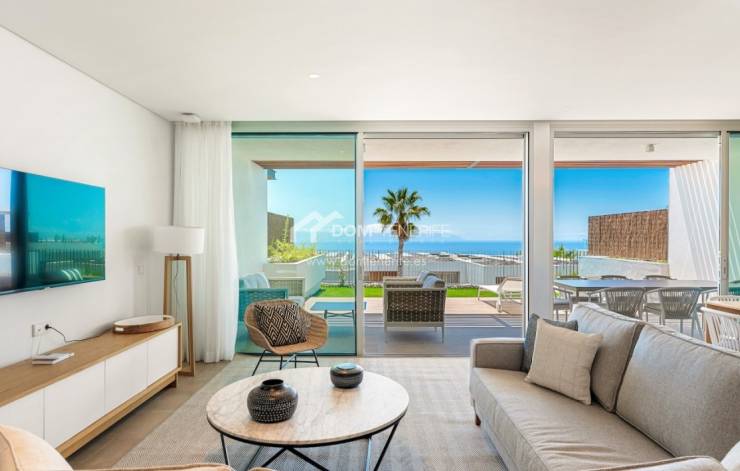
Holiday rental investors in Costa Adeje are predominantly high-net-worth individuals from Northern and Central Europe, the United Kingdom, and Russia. These buyers typically acquire properties between €500,000 and €3,000,000, viewing them as portfolio diversification rather than primary residence. Demand from Scandinavian and German buyers has remained consistent, driven by year-round sunshine and established tourism infrastructure. British purchasers favour direct beachfront positions; Northern Europeans frequently prioritise established communities with professional management. Over the past five years, average property values in Costa Adeje have appreciated steadily, reflecting sustained rental demand and limited supply of premium stock. Transaction volumes have remained resilient among this demographic, despite broader economic cycles. Properties in well-managed developments attract international buyers more readily than standalone villas requiring individual rental licensing.
Discover the development in detail
Floor plans, specifications and current availability, sent by one of our advisors in your language.
See the developmentWhatsApp
Beachfront villas in Costa Adeje command premium positioning. First-line ocean-view properties typically range from €2,500,000 to €6,000,000 depending on age, plot size, and modernisation level. Penthouses and townhouses in prime developments occupy a mid-tier segment, priced between €800,000 and €2,200,000, offering lower maintenance than detached villas while retaining rental appeal. Second-line apartments in established communities—those with 100–200 metres elevation from the shoreline—range from €400,000 to €1,200,000. Factors affecting positioning include pool inclusion, direct terrace orientation, community amenities, and management quality. Properties with professional rental administration command rental yields three to five percentage points higher than unmanaged stock. Age and renovation status significantly impact both acquisition cost and operational expenses; recently renovated units reduce maintenance risk in the competitive rental market.
Every purchase requires verification against the Catastro (Land Registry), confirming property boundaries, plot size, and construction classification. Urban planning status must be confirmed—whether the property holds valid licensing or operates under restricted use. Community of owners regulations and current charges require independent review; photographs alone do not reveal structural condition, water supply reliability, or electrical adequacy. Request recent community minutes, invoices for maintenance, and reserve fund certifications. Physical inspection during daylight should assess orientation (north-facing units yield lower rental income), exterior finishes, terrace drainage, and shared facilities functionality. Professional surveyors familiar with Canarian construction standards identify defects invisible in marketing imagery. Utility connections—mains water, sewerage, electricity—must be confirmed individually; properties in older complexes sometimes operate on private wells or septic systems requiring maintenance contracts.
Property transfer involves transfer tax (ITP) on resale purchases or value-added tax (IVA) on new construction, both calculated on purchase price. Municipal property tax (IBI) applies annually to all ownership. Upon resale, municipal gains tax applies on the appreciated portion of the property value. Non-resident sellers trigger mandatory withholding at a fixed percentage of sale proceeds, requiring formal notification. Rental income generated by non-residents remains subject to Spanish taxation; many investors establish a Spanish fiscal residency or corporate structure to optimise compliance. Annual income tax declaration (modelo 211) is mandatory for rental operations. Professional advice from accountants experienced in Canarian non-resident taxation prevents penalties and ensures regulatory compliance. Currency considerations affect net returns for non-euro investors; exchange risk should be calculated into long-term projections.
Never commit funds via informal deposit without a signed reservation contract detailing conditions, price, and completion timeline. Translation of deeds and contracts must be performed by certified legal translators, not automated services; terminology errors create title disputes. Community charges frequently exceed estimates; request three years of audited invoices before committing. Ignoring property orientation costs rental income—north-facing units in high-rise developments attract fewer bookings. Nighttime site visits prevent assessment of noise, traffic, and parking availability. Avoid purchasing without NIE (tax identification number) pre-registration, complicating later refinancing and tax compliance. Failing to obtain title insurance exposes buyers to prior claims. Proceeding without legal representation risks encountering undeclared encumbrances, utility arrears, or disputed boundaries. Seasonal rental demand variation requires understanding the destination’s calendar; off-season vacancy periods directly impact yield calculations.
DOM Tenerife executes full documentary verification of every property before client introduction, confirming Catastro status, municipal clearance, community standing, and utility connections. Upon offer acceptance, we arrange certified legal translation of all contracts and deeds by multilingual practitioners. We accompany clients through NIE registration, bank account establishment, and notarial deed execution, ensuring every step complies with Spanish and Canarian regulations. Post-acquisition, we manage property registration with the Land Registry, confirm tax filing deadlines, and coordinate handover. Our multilingual approach eliminates communication gaps between buyer, seller, notary, and municipal authorities. We identify and escalate title issues, encumbrances, or structural defects before purchase commitment. This structured accompaniment transforms a complex, high-risk process into transparent, documented procedure, protecting your capital and ensuring compliance.
Beachfront villas in Costa Adeje range from approximately €2,500,000 to €6,000,000 depending on plot size, age, and renovation status. Second-line villas with sea views typically fall between €1,500,000 and €3,500,000. Prices reflect location within the resort zone, direct access to amenities, and professional rental management availability. Recent market data indicates sustained appreciation for well-maintained properties in established communities.
Spanish banks extend mortgage facilities to non-residents, typically offering seventy to eighty percent loan-to-value ratios on documented rental income projections. Loan terms generally range from fifteen to twenty-five years, with interest rates competitive against international alternatives. Buyers require NIE registration, proof of income, and property valuation before approval. Some international lenders also finance Canarian purchases, occasionally at favourable terms for non-European buyers.
The timeline typically spans eight to twelve weeks from signed reservation contract to notarial deed registration. NIE registration requires one to two weeks; property due diligence and legal translation occupy three to four weeks. Notarial scheduling and Land Registry processing account for the remainder. Expedited processing is occasionally possible if all parties coordinate and no title complications arise, though twelve weeks remains standard.
Essential documents include a valid passport, proof of funds (bank statements or certified reference), and a fiscal address. Spanish authorities require NIE registration documentation and completed tax identification forms. You will need a power of attorney if executing contracts remotely. Professional legal translation of all overseas identification documents may be required by the notary.
Remote purchase is feasible but not recommended without professional local representation. Nighttime and daylight site visits reveal neighbourhood character, noise, and parking realities invisible in photography. DOM Tenerife’s accompaniment service eliminates distance risk through documented verification, certified translations, and on-site notarial presence. Video tours and professional site surveys supplement physical inspection, though in-person final viewing remains prudent before commitment.
Acquiring holiday rental property in Costa Adeje demands rigorous legal and financial oversight. DOM Tenerife’s commitment to ’Buy safely’ means comprehensive documentary verification, certified translation, multilingual notarial accompaniment, and post-acquisition support. We eliminate the risks inherent in international real estate transactions, ensuring your investment is legally secure, tax-compliant, and positioned for sustainable returns. Contact our team today via WhatsApp +34 673 560 035 to begin your acquisition journey with professional guidance at every stage.
Let’s talk whenever suits you
Video call, a meeting at our El Madroñal office, or WhatsApp on +34 673 560 035. We guide you from reservation to deed, in your language. DOM Tenerife — Buy safely.
Request informationMessage on WhatsApp#VV Canarias # alquiler vacacional tenerife rentabilidad
Phone
+34 922 089 199Mobile and whatsapp
+34 673 560 035
Address
Avenida Kurt Konrad Mayer 63, El Madroñal, 38660 Adeje, Santa Cruz de Tenerife, España.