
DOM Tenerife · Buyer insight
Golf del Sur and Amarilla Golf offer an alternative to the busier resorts of Costa Adeje—combining access to championship courses, marina facilities and residential calm. Both zones attract international buyers seeking year-round climate and proximity to Atlantic leisure infrastructure without the density of El Duque or La Caleta.
Buyers in Golf del Sur and Amarilla Golf typically originate from Northern and Central Europe, the United Kingdom, Belgium and France, drawn by the subtropical Atlantic climate and lower-density environment compared with Costa Adeje proper. Many seek a second residence or retirement base with golf access; others relocate for business or establish a long-term base while maintaining ties to their home countries. Demand has evolved toward quieter micro-zones within Tenerife South over the past five years, as buyers increasingly value proximity to specific amenities—golf courses, marina harbours, established European communities—over sheer resort prestige. This shift reflects a preference for year-round livability rather than seasonal tourism footfall, and a growing awareness that fairway-front or marina-view positions offer better long-term stability than high-density beachfront zones.
Golf del Sur and Amarilla Golf contain three distinct categories. Fairway-front or golf-view villas command the highest valuations, reflecting private gardens, full autonomy and unobstructed course or landscaped vistas. Mid-range properties—typically low-rise apartments or townhouses with golf or marina exposure—represent the largest segment. Entry-level apartments, positioned in second-line blocks away from fairways or harbour views, offer lower absolute prices and appeal to first-time or budget-conscious buyers. Within Amarilla Golf specifically, DOM Tenerife currently lists three homes at asking prices ranging from €338,500 to €1,590,000, with a median of €685,000. For a complete picture of available stock in both zones, direct consultation with our advisors will clarify exact positioning, aspect and current inventory by category.
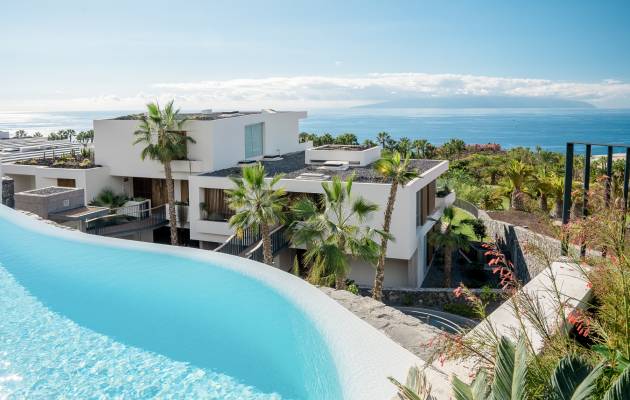
Abama Luxury Residences
New development selected by DOM Tenerife. Plans, prices and availability sent the same day.
Explore the developmentBoth Golf del Sur and Amarilla Golf operate under defined community governance; each property carries formal registration in the Catastro (Spanish Land Registry) and holds individual deed records filed at the Tenerife Property Registry. Examine the Catastro entry for accuracy of build area, year of construction and any encumbrances (servidumbre or easements tied to golf course maintenance or shared service roads). Request a full community (HOA) declaration detailing annual contributions, reserves and any pending special levies—golf course upkeep and marina facilities generate ongoing costs that vary by season. Do not rely on marketing photography: conduct a daylight structural survey covering roof, windows, waterproofing and mechanical systems, particularly in seafront-adjacent blocks where salt-spray exposure accelerates deterioration. Verify utilities (water supply, waste and electric connections) directly with the community administrator.
Buying a resale home in the Canary Islands incurs transfer tax (ITP) at 6.5% of the purchase price. If the seller is a non-resident, the buyer is legally required to withhold 3% of the price and remit it to the Spanish Tax Agency (Agencia Tributaria) within one month using form 211; failure to comply exposes the buyer to joint liability. First-time new-build purchases by the developer carry IGIC (Canary Islands general indirect tax) at 7%, plus stamp duty (AJD) on the notarised deed. Municipal capital gains tax (plusvalía) depends on the seller’s original acquisition cost and holding period; calculate this figure early with your gestor (tax advisor) to avoid surprises at closing. Annual property tax (IBI) is charged by the local municipality at rates varying by zone and property classification. Factor all three taxes into your affordability assessment before making an offer.
Do not pay a reservation fee without a signed reservation agreement detailing the conditions for return of funds should the sale collapse. Never attempt to translate the title deed yourself; use a sworn translator (traductor jurado) certified by the Ministerio de Asuntos Exteriores to avoid ambiguity in a legally binding document. Underestimating ongoing community fees is a frequent error—request a three-year history of actual charges, as golf course maintenance and marina administration can vary unexpectedly. Ignore property orientation and aspect at your peril; a north-facing apartment in a subtropical climate experiences significantly different sun exposure and cooling costs than a south-facing unit, and resale appeal depends heavily on this factor. Never schedule a viewing after dusk; poor lighting masks damp, damage and structural issues that daylight reveals. Visit the property at different times and seasons to assess noise, activity levels and suitability for your actual lifestyle.
Our role as your advisor begins with comprehensive document verification: we obtain and review the Catastro entry, community bylaws, deed chain, pending mortgage records and any environmental or zoning restrictions. We arrange certified translation of all deeds and contracts through an accredited legal translator, ensuring every term is understood before signature. We accompany you to the notary (notaría) where the purchase is formalised; our advisors remain present to clarify obligations, taxes and conditions in your language. We manage the NIE (foreigner identification number) application and coordinate post-closing registration of your deed with the Property Registry. After completion, we help you understand community procedures, utility setup and any warranted inspections. This continuity of legal support—from first viewing through registry registration—ensures you own a clear, unencumbered title and understand your rights and obligations as a property owner in the Canary Islands.
You are legally required to withhold 3% of the purchase price and pay it to the Spanish Tax Agency (Agencia Tributaria) using form 211 within one month of closing. Failure to do so makes you jointly liable for the unpaid tax. This withholding ensures the seller meets Spanish tax obligations on the sale. Your lawyer or gestor will manage this process on your behalf.
Resale purchases are taxed with transfer tax (ITP) at 6.5% of the purchase price. Additionally, there may be municipal capital gains tax (plusvalía) due by the seller, which can affect net proceeds. If the seller is non-resident, you also withhold 3% under form 211. Confirm exact figures with your tax advisor (gestor) before making an offer.
IGIC is the Canary Islands’ general indirect tax (7% rate). You pay it only when buying a new-build home directly from the developer as the first sale. Resale purchases are taxed with ITP instead. Stamp duty (AJD) on the notarised deed is payable in addition. Your advisor will clarify which tax regime applies to your specific property.
Yes, an NIE (foreigner identification number) is required to purchase real estate in Spain. Residency is not necessary. The NIE is issued by the Spanish National Police (Policía Nacional) and is straightforward to obtain with the help of a local advisor. We manage the NIE application process as part of your purchase journey.
The seller pays the agency commission; the percentage is agreed in writing in the listing agreement between the agency and seller. Buyers do not pay a separate commission. This arrangement is standard across Spanish property transactions and does not affect the buyer’s net cost.
A reservation fee paid without a signed, written agreement leaves you unprotected if the sale fails to proceed. You have no contractual right to recover the money. Always insist on a formal reservation document that specifies the conditions under which fees are refundable and the timeline for returning funds if circumstances change.
Self-translated deeds introduce legal ambiguity and may not be accepted by the notary or registry. Spanish property law uses precise terminology; mistranslations can obscure your actual rights, obligations or encumbrances. Always use a sworn translator (traductor jurado) certified by the Spanish Ministry of Foreign Affairs to ensure accuracy and legal validity.
Request a three-year history of actual community invoices from the community administrator (administrador). Golf and marina properties often have higher and more variable fees due to course maintenance and harbour upkeep. Reviewing real historical charges prevents underestimating your true annual costs and reveals any unexpected special levies.
The subtropical Atlantic climate means sun exposure directly affects comfort, cooling costs and summer usability. A north-facing apartment may feel cool but gloomy; a south-facing unit enjoys more natural light but higher air-conditioning demand. Orientation also influences long-term resale appeal and rental potential if you later decide to lease the property.
Always visit during daylight, ideally at different times and seasons, to assess natural light, noise levels, activity and true condition. Inspect roof, windows, waterproofing and mechanical systems in person. Request documentation of any prior repairs or renovations. Never rely on photographs alone; structural issues, damp, salt spray damage and poor finishes are only visible in person and in proper light.
Buying property in Golf del Sur or Amarilla Golf requires careful verification of documents, tax obligations and physical condition—steps that are best guided by an advisor familiar with both the micro-zones and Canary Islands property law. DOM Tenerife accompanies you through full legal verification, certified translation of all deeds, notarial representation and post-purchase registry support, ensuring a safe, transparent acquisition. Contact us via WhatsApp +34 673 560 035 to discuss your requirements and tour available homes in either zone.
Let’s talk whenever suits you
Video call, a meeting at our El Madroñal office, or WhatsApp on +34 673 560 035. We guide you from reservation to deed, in your language. DOM Tenerife — Buy safely.
Request informationMessage on WhatsApp#propiedades en golf del sur # tenerife luxury real estate # dom tenerife # south tenerife property # hnwi tenerife buyer
Phone
+34 922 089 199Mobile and whatsapp
+34 673 560 035
Address
Avenida Kurt Konrad Mayer 63, El Madroñal, 38660 Adeje, Santa Cruz de Tenerife, España.