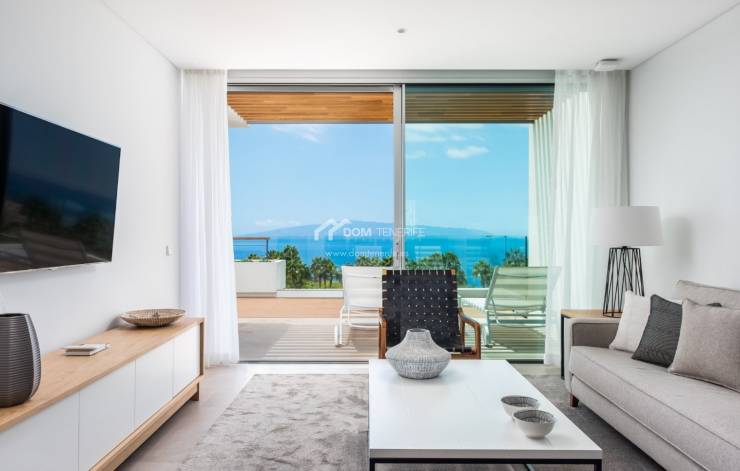
DOM Tenerife · Insight
The distinction between true oceanfront and sea-view properties in Tenerife South carries legal, fiscal and valuation consequences that demand precise understanding. Spanish coastal regulation, municipal zoning and notarial interpretation create a framework within which the term ’frontline’ operates—and misunderstanding it can cost buyers significantly at purchase and resale.
Oceanfront and frontline acquisitions in Tenerife South attract primarily Northern and Central European buyers, alongside established UK and Russian purchasers seeking Atlantic-facing exposure. These high-net-worth clients value the combination of legal transparency, established infrastructure in zones such as El Duque, Costa Adeje and Abama, and the region’s subtropical climate stability. Over the past five years, properties with certified oceanfront position have appreciated steadily, with premium pricing for direct beachfront access and unobstructed southern or western orientation. Buyers from Scandinavia, Germany and the Netherlands represent a growing segment seeking year-round mild conditions and established estate communities. Market demand for true frontline property remains resilient, driven by wealth diversification and second-home acquisition patterns among established European high-net-worth individuals.
Discover the development in detail
Floor plans, specifications and current availability, sent by one of our advisors in your language.
See the developmentWhatsApp
Oceanfront villas with direct beach access command the highest valuation brackets within Tenerife South’s luxury segment. Frontline apartments and penthouses occupy an intermediate tier, offering certified proximity to the coastline while sharing common facilities and lower maintenance obligations than standalone villas. Second-line residences—those positioned one or more plots inland—represent a distinct asset class with measurably lower per-square-metre valuations despite occasional partial sea views. Villa pricing, amenity set and architectural specification vary significantly by development: Abama’s branded residences and El Madroñal’s gated estates differ fundamentally from Costa Adeje’s mid-market frontline stock. Accurate positioning depends on catastral registration, coastal zoning classification, and sight-line verification. Professional appraisal must confirm whether a property qualifies as ’primera línea’ under local municipal definition, as this classification directly influences resale value, rental potential and financing terms offered by Spanish and foreign lenders.
Spanish property ownership depends on catastral accuracy—the municipal land registry that defines plot boundaries, building footprint and legal classification. Coastal properties in Tenerife South fall under maritime-terrestrial jurisdiction, meaning access rights, building setbacks and structural permissions differ from inland plots. Second-line properties may carry restrictions preventing future beachfront development, while true oceanfront plots face stringent limitations on modification or extension. Community of owners (comunidad de propietarios) obligations are binding and non-negotiable; unpaid fees create liens against the property. Visual inspection alone cannot confirm structural integrity: concrete quality, damp penetration, electrical and plumbing age, and balcony safety require professional surveying. Many frontline properties face salt-spray corrosion, requiring specialist remediation. The photograph presented by agents is rarely representative of actual maintenance condition, seasonal usage patterns, or rental demand during Atlantic storm seasons.
Spanish property acquisition incurs Impuesto sobre Transmisiones Patrimoniales (ITP) on resale properties and IVA (value-added tax) on new-build transactions. Municipal plus-value tax (plusvalía) applies based on land appreciation during the seller’s ownership period. Annual Impuesto sobre Bienes Inmuebles (IBI) is levied on all property owners. Non-resident vendors face mandatory 3% withholding at completion, reducing net proceeds. Modelo 211 reporting obligations apply to all transactions; failure to declare creates compliance risk with Spanish tax authorities. Property acquisition requires NIE (personal tax identification number) and an active Spanish bank account for fund transfers and ongoing tax payment. Rental income—whether actual or imputed for luxury second homes—carries separate declaration obligations under Spain’s global income tax regime. Cross-border buyers must engage licensed gestoría (tax administration specialists) to navigate cumulative obligations and avoid future audit exposure.
Deposit payment without a signed reservation agreement (contrato privado) leaves buyers without legal recourse if the seller withdraws. Many agents present contracts in Spanish only; translation by qualified legal counsel is non-negotiable, as notarial language contains obligations not apparent in English summaries. Community fee arrears—often substantial in older beachfront buildings—transfer to new owners as inherited liability; verification is essential before commitment. Coastal orientation (southern exposure versus northern aspect) fundamentally affects usability, heating costs, and resale appeal; evening site visits reveal light quality and seasonal sun angle. Properties marketed as ’frontline’ may occupy second or third positions in mixed-development complexes, with restricted beach access via shared paths. Insufficient attention to municipal zoning restrictions, future construction permits for adjoining plots, or maritime jurisdiction changes can render expensive properties legally unbuildable and unmodifiable after purchase.
Complete oceanfront acquisition requires certified legal review of all catastral documents, municipal zoning certificates (cédula de habitabilidad), community of owners bylaws, and fiscal compliance records. Professional translation of the purchase contract (compraventa) and notarial deed (escritura) by qualified legal translators ensures alignment between buyer intent and binding Spanish legal language. Notarial completion in Tenerife South requires presence before a licensed notary public (notario), who verifies identities, funds transfer, and registration at the Registro de la Propiedad (property registry). Post-purchase management encompasses NIE activation, tax registration, community payment enrollment, and initial property compliance inspection. DOM Tenerife Real Estate provides multilingual accompaniment throughout—from preliminary due diligence through notarial signature to registry confirmation—ensuring buyers avoid contractual ambiguity and fiscal exposure. The complexity of Spanish coastal property law and international ownership structures demands specialist guidance; independent verification protects capital and secures long-term legal standing.
’Primera línea’ refers to properties with direct, unobstructed access to the coastline, typically confirmed by catastral mapping and municipal zoning. The precise definition varies by municipality; in Tenerife South, certified frontline status affects financing, valuation, and resale positioning. Professional legal verification of catastral documents is essential, as visual proximity alone does not constitute legal frontline classification.
Foreign buyers must obtain a NIE (Número de Identidad de Extranjero) from Spanish authorities, establish a Spanish bank account, and engage a licensed gestoría for tax compliance. Full legal representation through a Spanish abogado (solicitor) is standard practice. Property ownership is unrestricted for EU and non-EU buyers; acquisition follows identical notarial procedures as Spanish residents.
Annual IBI (property tax), declaration of any rental income, and compliance with Spain’s global income tax regime apply to all owners. Non-residents may face imputed income taxation on luxury second homes. Transfer tax (ITP) or VAT applies at purchase; municipal plus-value tax may be owed by the seller. Modelo 211 reporting is mandatory.
No. Community fees are binding monthly or annual obligations; arrears create statutory liens against the property and transfer to new owners as inherited debt. Verification of outstanding balances before completion is critical, as buyers cannot contest or refuse payment without losing legal standing in the building.
Salt-spray corrosion of concrete, balcony deterioration, damp penetration, and outdated electrical or plumbing systems are endemic in properties near the Atlantic. Professional surveying by qualified engineers is essential; photographic marketing rarely reflects actual maintenance condition or remediation costs.
Spanish notarial deeds contain binding obligations, tax declarations, and liability assumptions that differ from English-language contract summaries. Qualified legal translation ensures buyer understanding of every clause and prevents post-completion disputes over ownership rights, community obligations, or fiscal liability.
Mandatory 3% withholding from the purchase price is deducted and remitted to Spanish tax authorities. This withholding protects the buyer from inherited liability; the seller’s proceeds are reduced by this amount. Verification of seller residency status is part of standard due diligence.
Maritime-terrestrial jurisdiction prohibits major structural modifications, extensions, or new construction on certified oceanfront plots without explicit municipal permits. These permits are rarely granted; buyers cannot assume the right to alter, extend, or develop oceanfront properties after purchase without prior legal verification of specific entitlements.
Second-line properties sit one or more plots inland, typically offering partial sea views but no direct beach access. Valuation, rental demand, and resale velocity differ markedly; municipal zoning often prohibits future development on intervening land, permanently securing second-line properties’ view status but also restricting their upgrade potential.
Coastal orientation affects natural light, heating costs, and seasonal usability fundamentally. Evening and early-morning visits reveal actual sun angle, noise from beach activity, and moisture conditions. Daytime-only viewings mask winter light loss, Atlantic wind exposure, and seasonal rental competition patterns that impact long-term satisfaction and resale appeal.
Oceanfront acquisition in Tenerife South demands precision in legal classification, fiscal planning, and structural assessment. DOM Tenerife Real Estate provides complete documentation verification, professional translation, notarial accompaniment, and post-purchase management—ensuring transparent, legally secure transactions aligned with international best practices. Buy safely. Contact us via WhatsApp +34 673 560 035 to discuss your oceanfront requirements with multilingual specialists familiar with every zone, every development, and every fiscal obligation.
Let’s talk whenever suits you
Video call, a meeting at our El Madroñal office, or WhatsApp on +34 673 560 035. We guide you from reservation to deed, in your language. DOM Tenerife — Buy safely.
Request informationMessage on WhatsApp#propiedades frente al mar tenerife # tenerife luxury real estate # dom tenerife # south tenerife property # hnwi tenerife buyer
Phone
+34 922 089 199Mobile and whatsapp
+34 673 560 035
Address
Avenida Kurt Konrad Mayer 63, El Madroñal, 38660 Adeje, Santa Cruz de Tenerife, España.